

Author Interview with C.C. Urie
Disclaimer: As an Amazon Associate, I earn from purchases made through the affiliate links included in this post. This means if you click on the link and make a purchase, I will receive an affiliate commission at no extra cost to you. See the Privacy Policy for more information.
Finding a good books that keeps you hooked without diving into overly mature themes can feel like searching for a needle in a haystack, right?
That’s where C.C. Urie comes in.
She’s an indie author who’s nailed the art of writing clean yet totally captivating stories. Trust me, I’ve read her work, and I couldn’t put it down! Her imaginative worlds pull you in and keep you turning the pages.
As someone who’s spent way too much time devouring indie books (seriously, my Kindle is packed), I can confidently say that indie authors bring such a fresh and creative vibe to the genre. And C.C. Urie? She’s no exception.
Want to know more about what makes her? I had the chance to interview her and get the inside scoop on her writing process, her inspiration, and how she crafts stories that are both exciting and clean—perfect for YA readers.
If you’re on the hunt for trustworthy recommendations (because who has time for endless scrolling?), C.C. Urie’s books are a must-read. They’re refreshing, engaging, and just plain fun.
So, grab a cozy drink, and settle in.
Ready to meet the mind behind the magic? Let’s go!
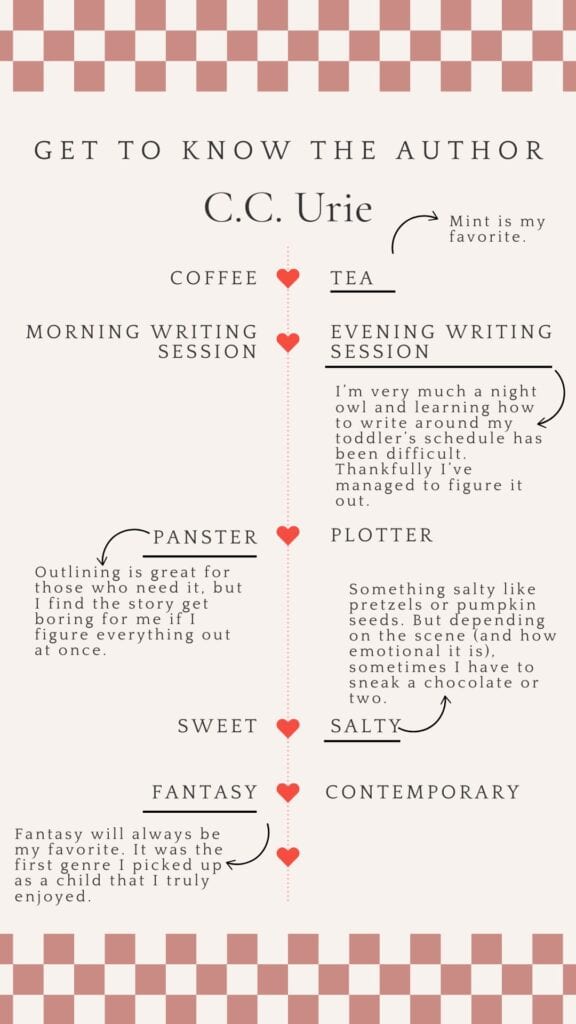
Get to know the author
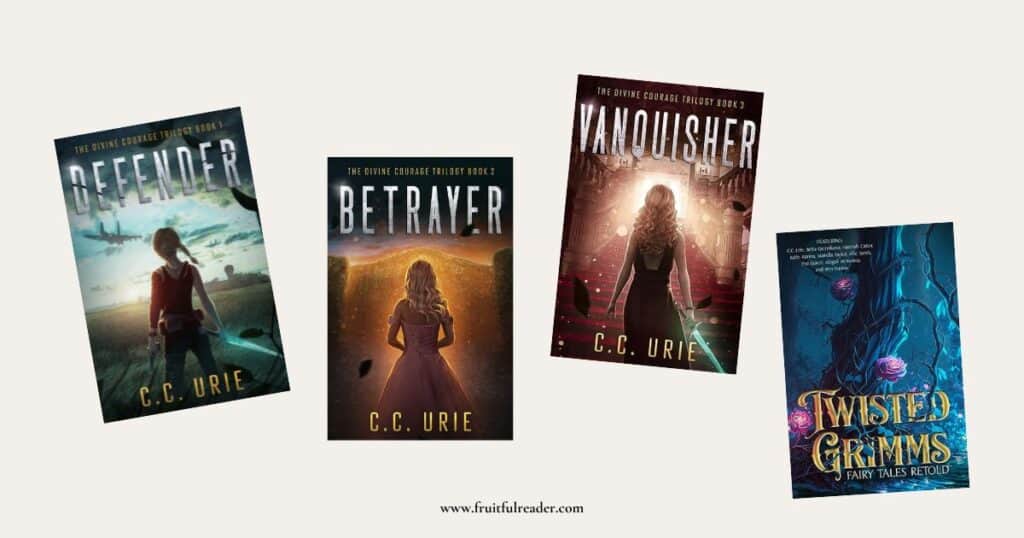
Books by C.C. Urie
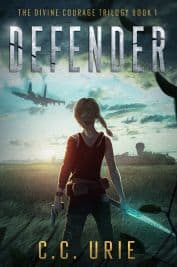
Rating: ⭐️⭐️⭐️⭐️☆ 4.27 out of 5 Stars | 📚 Genre: Dystopia Science Fiction, Romance | 💝 On Kindle Unlimited | ✅ Read it!
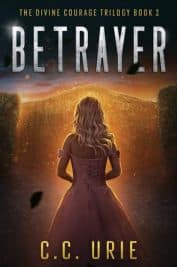
Rating: ⭐️⭐️⭐️⭐️☆ 4.52 out of 5 Stars | 📚 Genre: Dystopia Science Fiction, Romance | 💝 On Kindle Unlimited | ✅ Read it!
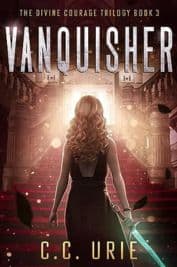
Rating: ⭐️⭐️⭐️⭐️☆ 4.41 out of 5 Stars | 📚 Genre: Dystopia Science Fiction, Romance | 💝 On Kindle Unlimited | ✅ Read it!
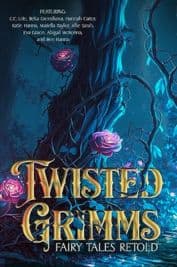
Rating: ⭐️⭐️⭐️⭐️☆ 3.88 out of 5 Stars | 📚 Genre: Fairy Tale Retellings | 💝 On Kindle Unlimited | ✅ Read it!
Writing Journey & Inspiration
1. What inspired you to become a multi-genre Christian author, and how has your journey been so far?
I didn’t plan on being a multi-genre author. I was going to only write speculative fiction and I was pretty content with that. The thing that changed my mind was an idea I had when I was trying to finish writing one of my fantasies.
I didn’t know what to do with it, so I originally wrote it as a dystopian, with next to no dystopian in it. I was trying so hard to force the genre because (according to my author groups) people just didn’t switch sides.
But nothing I did made the flow of the story work. That’s when I realized that I was trying to force a story God had blessed me with into the wrong genre. It wasn’t working because it wasn’t mine.
Now it’s written as a Contemporary Christian Romance with an estimated release timeframe of October 2025. Needless to say, I embraced the multi-genre title and haven’t looked back since.
2. Can you share a pivotal moment when you felt God’s guidance in your writing career?
I always wrote for fun growing up. It was a hobby and I didn’t expect it to be anything more. Being an author isn’t a secure job and I was raised to find something practical. But whenever I worked at a “grownup” job, my life always took a turn for the worse.
I would get bullied by middle-aged Karens because they would rather I quit and fire me themselves, or sexually harassed by line cooks in restaurants. I didn’t have a college degree because everything I tried to pursue fell out.
I’m not kidding, I had 3 different four year universities lose my community college transcript and wanted me to pay to send it again. I had no options than to suck up my misery and vent about it in my fictional worlds.
At my last working job, I got pushed too far and ended up quitting. My husband at the time told me I could have one year to finish a book. I did it, and once it was done, he lost his job. God has called me to be an author, and that’s what I’ll be until my last breath.

3. How do you integrate strong Biblical themes into your stories while appealing to a broad audience?
First and foremost, I’m NOT a pastor. I have no business telling anyone what they should or should not be doing with their lives. I think because I understand that, it’s easier for me to not be so fire and brimstone. On top of that, I write about who God is to me personally.
I show love, hope, forgiveness, and light—things that I think everyone wants to see, not just us Christians. This, to me, lets me blur the lines a little bit without being so in your face. Yes, I have Christian characters, but I have characters that aren’t Christian as well. I don’t sugarcoat those characters.
If they’re evil, then I’m going to write them as evil.
Which (if you read the Divine Courage Trilogy) is why there’s so much hate for Dominic. And it’s justified! Because there’s this fine line drawn, I can slip in things like Biblical references or themes that can be enjoyed by everyone but hold an extra level of understanding for Christians.
Think about Lord of the Rings. You don’t have to be a Christian to enjoy the story, but the ones who understand what it really means when Aragorn accepts his crown really understand how beautiful the second layer of the story really is.
4. What challenges have you encountered as an indie author in the Christian fiction genre, and how have you overcome them?
I’m not sure I have. I’ve been part of the Christian Indie Community my whole career and they’ve always been my target audience. I feel I have the normal struggles of trying to sell books, write them, and market them, but I don’t think my chosen direction has anything to do with that.
If anything, I have an advantage as the world grows more and more angry about slipping smut in where it can. It probably helps that I don’t jump out of bed every morning shouting “I’m going to be bigger than Rowling, Tolkien, Lewis, Martin, and King combined!”
I am able to call myself an author because that’s what God wants me to do. If that means I break even and my book only makes an impact on one person, then my career will be worth it.

Behind the Books
1. Your Divine Courage Trilogy is described as a dystopian retelling of Esther. What drew you to retell this particular biblical story in a dystopian setting?
It was an instantaneous idea, actually. I was suffering through yet another dystopian about a 16 year old girl who was good at everything, ugly but somehow the prettiest girl in the book, and debating on who she should share her “first time” with when I asked myself “Why are there no Christian books like this?”
This of course made me wonder what a Christian dystopian would look like and what kind of Biblical woman would make a “Chosen One” I would actually like. Then I realized, the Bible already had a woman that checked all the boxes. Once I decided to do an Esther Retelling, the Trilogy just sort of wrote itself.
2. Among your characters, do you have a favorite or one that resonates with you personally?
I really like Vallen. He’s there. He steps up. He wants to be involved. Vallen is the dad that so many of us don’t get. But my absolute favorite character from the Trilogy is Delvon. Unfortunately, I can’t go into more details because of spoilers, but I love everything about him.
He was a happy accident and I didn’t mean for him to be as big of a part as he was, but I’m so happy he stubbornly pushed his way in. As I was writing the Trilogy, it was his voice telling me “If we’re going to do this, then we’re going to do this right.”
3. Can you give us a glimpse into your upcoming projects, such as the Christian fantasy and romance works in progress?
The Contemporary Christian Romance will hopefully be coming out this year. I’m going to try everything in my power to get it out. That means I’m going to promote it like crazy, look for other authors to endorse it, and even take a stab at a Kickstarter.
I’m so excited for this book and it’s one of the ones I’m most proud of writing. It deals with redemption, forgiveness, and learning humility, as well as grittier topics like overcoming sin, accepting help from others, and letting go of your past. It’s going to take place in a small town in Kansas and will have tropes like he chases her, found family, he gets better for her, and second chances.
For a Christian book, I’m going to be tackling things that I haven’t personally seen in the genre before. The MMC is a con-man running from the law and the mob, so things get a little dark. I also show a breakup in the book. The couple at the beginning is not the couple at the end. Not only that, but I’m going to have a good, clean, festive Halloween party in the book too.
This book will be free of skimpy costumes, drunken makeout sessions with strangers in masks, or why choose options usually found in Halloween romances.
The fantasy series will be a 9-book Christian Dark Romantasy series that deals with themes like loss, forgiveness, and learning to trust God first.
This series gets into it. The first book alone has unexpected (but realistic) murders, political agendas, good versus evil, and all the other things you hope to find in a medieval-style fantasy.
This one has a lot of the tropes I frequently write like enemies to lovers, forced proximity, found family, and he falls first. My goal is to get the first couple books into the hands of my editor this year and have a small rapid release in 2026.

4. How do you ensure your stories remain engaging and relatable while maintaining clean content?
I write the kind of stuff I want to read. I know that’s lame and overused, but it’s true. If you don’t enjoy what you’re doing, then others won’t either. Staying clean is easy because anything more than a steamy kiss or high tension makes me uncomfortable, but sometimes I go a little too far with the violence. But, that’s what editors are for.
As for what I actively do to try and keep the story interesting, is take a Bible story or verse and throw it in the book as a prompt.
It helps me out of my slump, forces me to think about what direction I want to go in, and helps keep me close to God in my writing journey.
5. What made you decide to include more gritty, real characters not often seen in Christian fiction?
I hate pretty things. I’m sorry, but I do. I can’t stand reading books where the character’s biggest problem is that they don’t know if their extremely Christian husband is going to forgive them for accidentally telling a small lie that changes nothing in the actual story.
Spoiler alert, he does end up forgiving her. I don’t like it, and I want no part of it. Life, let alone Christianity, is HARD! My books are meant to show people that it gets better. I can’t do that when my whole storyline is “Oh no! Susie burned the cookies for the church auction and now she doesn’t know what she’s going to do!”
God comes to me every single time at my darkest, and that’s what I’m going to show. Hope is not dead, and sometimes you need it to be dark so you can see the light.
6. What do you hope readers gain from your books, both spiritually and emotionally?
I want them to know that they matter and that they’re loved. My characters are all broken. They have doubts, fears, and anxieties just like we do.
We all love characters like that. And they’re made up! How much more are we as flesh and blood than words on paper? You don’t have to have certain beliefs or lifestyles to deserve love. You are given it freely by someone, even if you don’t know it.
Things really do get better, and I hope people feel less alone and a little more loved when they read my books.
Faith & Personal Life
1. In what ways does your faith influence your daily writing process?
I’m not sure if it does. I write when I have time. Sometimes that’s once a day, other times that’s once a month. I will say that when I have writer’s block or I’m having a hard time getting through a scene, I pray about what to do.
I pray over my computer a LOT. I have this thing I call a Work Bible that I reference as well. It’s an XL Journaling NIV Bible, but instead of using it to study, I make notes for my books in it. It’s great for when my Pastor says something in church that sparks an idea, or if I get one while doing my own Bible studies.
I color code by book, underline the verses I want to reference (either directly or indirectly) in my book, and on the journaling side I write the idea and how it ties into my books. It helps me stay true to the source and remember the themes I’m going for.
2. Is there a specific Bible verse that inspires your work or holds special meaning for you?
Each book idea comes with its own verse. Not only that, but I parallel ideas too. Take my Divine Courage Trilogy. It’s an Esther Retelling, but the opening verses for the three books are Isaiah 60:1-3.
3. What role does prayer play in your creative endeavors and decision-making as an author?
I don’t do anything without praying. If there’s a scene I’m on the fence about, or a topic that I know will rock the boat, or even something I don’t want to write but know I’m called to include, I pray.
I pray over my Work Bible, I pray over my hands, I pray over my books before signings, and I pray over my computer.
I am an author because God allows it. I know how easily it can be taken away from me.
My books are OF Him and FOR Him.
4. How do you handle reader feedback, especially when it pertains to the themes in your books?
It depends on how the feedback is presented. If I can tell the reviewer is being mean just to be mean, then yeah it’s gonna hurt.
I understand my books aren’t for everyone, just like I don’t like all the books I read. But then there’s reviewers who completely miss the point of the book or scene. For example, one reader had an issue with Larken (the FMC of my Divine Courage Trilogy).
As one of Larken’s faults, she keeps going back to people who hurt her and trusts them when they say they won’t do it again.
She’s desperate for acceptance and it doesn’t always work out for her. One character in particular takes advantage of this, and when Larken finally cracks and stands up for herself, the reviewer blamed Larken for the way the narcissistic character tries to beat her back down into place.
The only thing I can do is ignore people like that. As for the good reviews, they make me happy for days.
Never underestimate what kind words can do for an author!
Book Recommendations & Fun Extras
1. What are some of your favorite Christian or clean fiction books that you would recommend to your readers?
I love Morgan L. Busse and Karen Witemeyer.
2. If you could have a conversation with any author, past or present, who would it be and why?
Jane Austen. She was a woman ahead of her time and I would love to learn anything she might have to teach.
3. What advice would you offer to aspiring authors looking to write in the Christian fiction genre?
Make sure you’re on the same page with God before you start, and listen to what He tells you to write. I know many authors who tried to force it and it didn’t end well for them.
Then your next step would be to start supporting as many authors as you can. I am more willing to be involved with authors who supported me than I am with the ones who blew me off.
4. Just for fun: If your life were a book, what would its title be?
Her Beautiful Mess
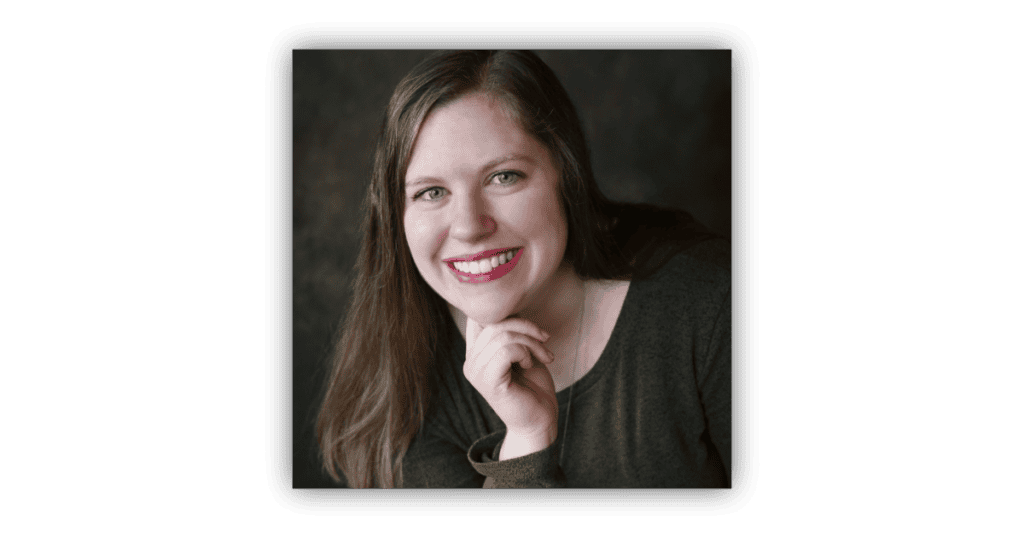
Connect with C.C. Urie
As we wrap up our chat with the amazing C.C. Urie, one thing’s crystal clear—her passion for storytelling and the incredible worlds she creates are seriously inspiring.
She gave us such a cool behind-the-scenes look at her writing process, and honestly, it makes you appreciate her books even more.
Curious about C.C. Urie’s journey and her stories? Why not jump right in? You can grab her books on Amazon and lose yourself in the magic she weaves.
And here’s a little bonus for all you Kindle Unlimited folks—you can start reading her work right now without spending an extra penny. So, what are you waiting for? Dive into her world and get ready to be hooked.
Grab your copy of Defender here!
And make sure to follow her on all the socials!
Joining her email list here: https://dashboard.mailerlite.com/forms/952654/121718822798362507/share
Following on Instagram: https://www.instagram.com/c.c.urie/
Like her Facebook page: https://m.facebook.com/authorc.c.urie/
Happy reading, friends!

